
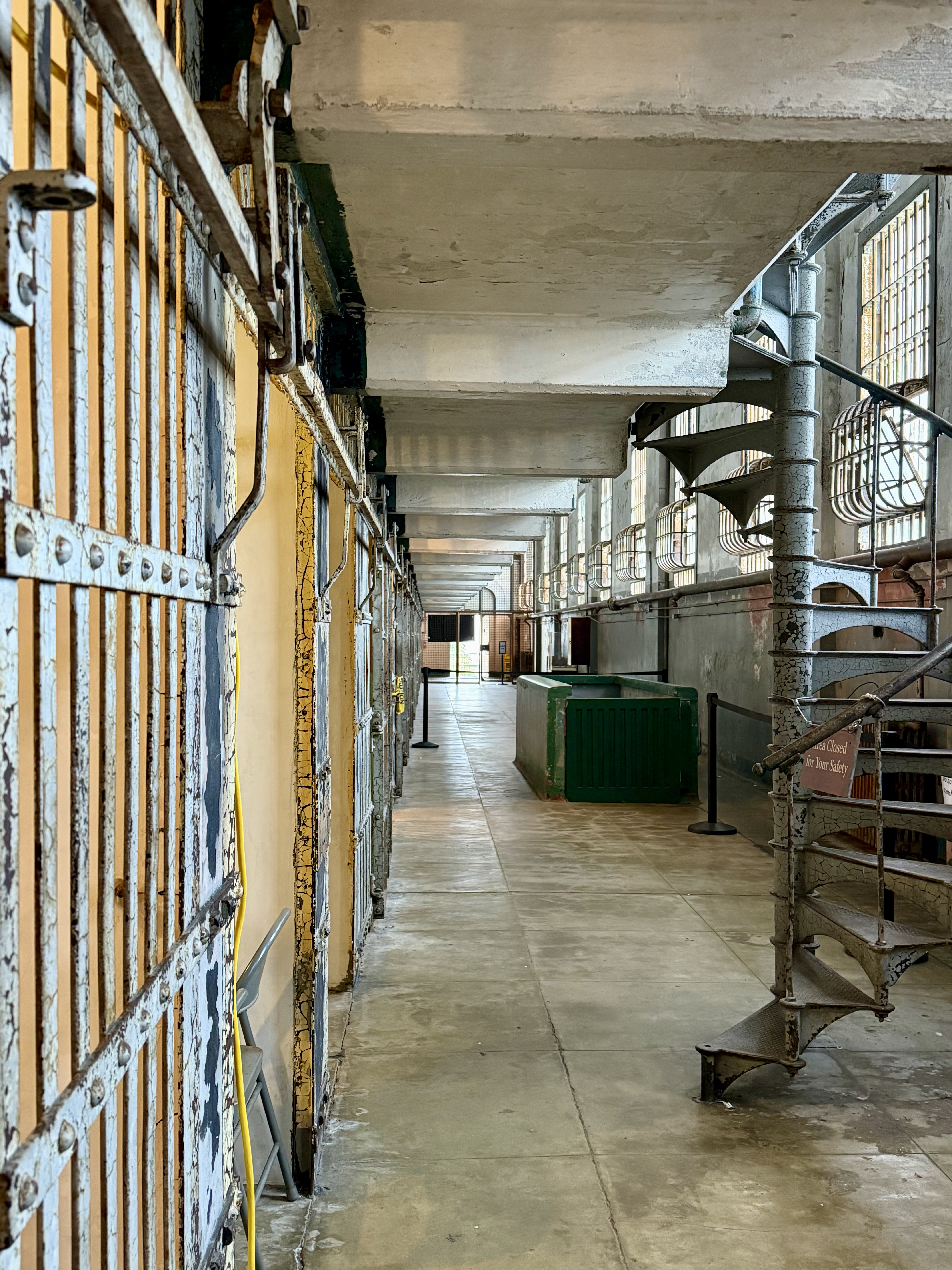

The weather cast a somber tone as my behind-the-scenes group bypassed the main tour entrance and stepped into the deserted prison, the echoes of our shoes squeaking in the abandoned confines of Alcatraz.


The thick aroma of steel and lead-laden paint flakes assaulted my tongue with a metallic taste. A narrow spiral staircase connected the ground level to the next two landings, while a gated door, which seemed far too short to be secure, separated the cell blocks from our holding area.


After passing through Visitation, the natural barrier between civilians and prisoners, we stepped into the B Block group of cells.


I was surprised at how uniform the prison had been built, with everything appearing so precise and even. Other prisons I’ve visited had some level of asymmetry or a sense that part of the prison was newer than the rest, but this one was different.

I soon realized what that difference was— Alcatraz was a military prison. In other words: a place of perfect order, cleanliness, and regulation.

Next, we got to go somewhere few get to venture— down the basement stairs, straight into the infamous dungeons of Alcatraz.
The dungeons were located inside the original 1850s citadel, underneath the main prison. Alcatraz has a sandwiched core of layer upon layer of historical architecture. That’s because there’s a tradition of simply building new structures on top of existing ones.

I asked about the significance of the number one and was told that I was looking at a rifle port.

The prison’s cellar was also used by inmates working kitchen duty. Food and supplies were stored there, and the prisoners exploited the opportunity, at one point even setting up a distillery by fermenting raisins and other fruits.

The dungeons were a cavernous place, and I imagined that any location in this basement would indeed be a bleak place to be kept. After what felt like an eternity, I halted in front of a group of cells. The doors had long ago been stripped, and only the cavern hollows remained. Those living in the cells for days and weeks at a time developed tricks to ‘see’, such as cupping their eyes and focusing on a pinpoint space. Still, it was impossible to envision what it’d be like to dwell in such blackness.
Until the lights were shut off.

Yup. All the lights. As the last illumination faded, dead silence loomed. I searched the expressions of those around me, wanting to know how others were experiencing this. But I couldn’t see their faces— not even the glint of an eyeball. There wasn’t anything to catch a reflection on. And that was without doors! What would it be like to be shut in? To be without light in a desperate hole of space, left to the mercy of others to survive?

As another cool perk of my behind-the-scenes pass, I was granted a close-up of the four cells involved in Alcatraz’s most infamous escape, the one that inspired the movie ‘Escape from Alcatraz.’ Four prisoners tunneled through the walls behind their cells, up the ventilation system, and out a ceiling cap they’d intentionally loosened. Those inmates were Frank Lee Morris, John Anglin, and Clarence Anglin— all presumed dead in the attempt— as well as Allen Clayton West, who surrendered after getting a late start and being left behind. The four of them modified utensils to dig through the crumbling concrete behind the sinks in their cells and disguised the holes with cardboard during the day.

I also learned a valuable piece of insider information that most accounts are missing—information that has even been omitted from the main Alcatraz audio tour.

One of the escapees, Allen West, convinced the warden to wall off the entire section above their cells. And not just for a day or two, but for months! Under the guise of keeping debris from falling to the main floor while painting, the prisoners worked together, concealed by a floor-to-ceiling canvas, carving a pathway through the ventilation system and building life-like dummies with real hair. They even constructed a raft and life preservers from fifty stolen rain jackets and fashioned oars from instruments. If not for the cloth, the inmates wouldn’t have had space to construct such elaborate work, let alone a place to store the items.

Officials closed the case in 1979 by marking the three outstanding inmates as presumed deceased, 17 years after their escape. They claim the trio could not have survived, but with a raft, makeshift oars, and such a well-thought-out plan, surely the group stood an excellent chance. There is, however, speculation that one of the prisoners died after a bloodstained-covered life preserver and the personal effects of Clarence Anglin washed ashore. Later reports of a denim-clad body floating down the San Francisco Bay were speculated to belong to one of the missing inmates. All three fugitives would be nearly 100 years old if they were still alive today.

Remnants of the Native American occupation of Alcatraz, which occurred after the prison was shut down, are scattered throughout the facility, adding to the institution’s foreboding atmosphere.

March 21st, 1963, the last day Alcatraz was in operation, started like all others, with breakfast in the ‘Gas Chamber’— aka, the dining hall. It’d been constructed with 14 canisters of tear gas built into the ceiling and could be locked down remotely.

Officials were wary of mealtime because all the prisoners were gathered in one place and a wide range of natural and man-made items were available, including hot drinks, bones, utensils, and cutlery. But the constant threat of a lockdown gassing generally kept the inmates in line, and the canisters were never fired.

Silhouettes made it obvious at a glance which knives were missing, and officers counted utensils before allowing each table to be dismissed from the hall. Despite the threat literally hanging over their heads, the food at Alcatraz was considered the best of all prisons, and inmates were allowed to eat as much as they wanted, as long as none went to waste.

Door racking demonstration below— turn up your volume to hear that infamous clang.
One block of cells stood out beyond all the rest— D Block, a segregated punishment unit comprising 42 cells, each one designed to impose varying levels of discomfort on its occupants.

The dungeons were discontinued in favor of the unit’s five strip-cells, where prisoners were stripped naked and left in the dark without a place to sit or even go to the bathroom. The inmates were forced to relieve themselves into a hole in the floor that got flushed at the guard’s discretion. A mattress and blanket were provided at night and taken away at daybreak.

Other cells contained a toilet, sink, and bleak 25-watt light. Even a home within the ‘normal’ cells came with severe restrictions, such as only being allowed out of cells three times a week: once for a trip to the recreation yard and twice for showers.

D Block was also home to Robert Stroud— aka, the infamous Birdman of Alcatraz. Robert gained fame by studying and writing books about bird diseases while in prison.

He was also a diagnosed psychopath who managed to incite a riot without ever being introduced to the general inmate population, and he did so just because he was bored.

After pulling that stunt, Stroud was sentenced to spend his remaining 11 years in Alcatraz’s hospital, much of that time as its sole patient, strapped to a bed.


I visited Alcatraz to tour one of the world’s most notorious prisons, but also discovered the footprints of a forgotten community. Dedicated apartment housing allowed the wives and children of prison personnel to live on the island.

Children rode the ferry to and from the mainland daily to go to school. Balls and other regular events provided residents a semblance of normal life, though it was peppered with mandatory escape drills.


More than a prison, Alcatraz is a place where wives tended gardens and children played while inmates lay tucked away in cold cells atop the only stone in the entire world famous enough to be known simply as The Rock.
Miss Alcatraz Part One?
Find it here.
I used the following sources to write this article (and happily lugged all of them home with me from the island’s gift shop):
Golden Gate National Parks Conservancy. Alcatraz Escape Files: From the Official Records. San Francisco: Golden Gate National Parks Conservancy, 2014.
Esslinger, Michael. Alcatraz: A History of the Penitentiary Years. Auburn, CA: Ocean View Publishing, 2003.
Kincade, Cory. Alcatraz Most Wanted: Profiles of the Most Famous Prisoners on the Rock. San Rafael, CA: Ariel Vamp Press, 2008.
National Park Service. Save the Rock: Exposing the Layers of an American Landmark. Pamphlet. Washington, DC: U.S. Department of the Interior, 2011.



Leave a Reply